SALARSNET · COIN HISTORIES
Fausta Bronze Coins: Imperial Portraits and One More Place
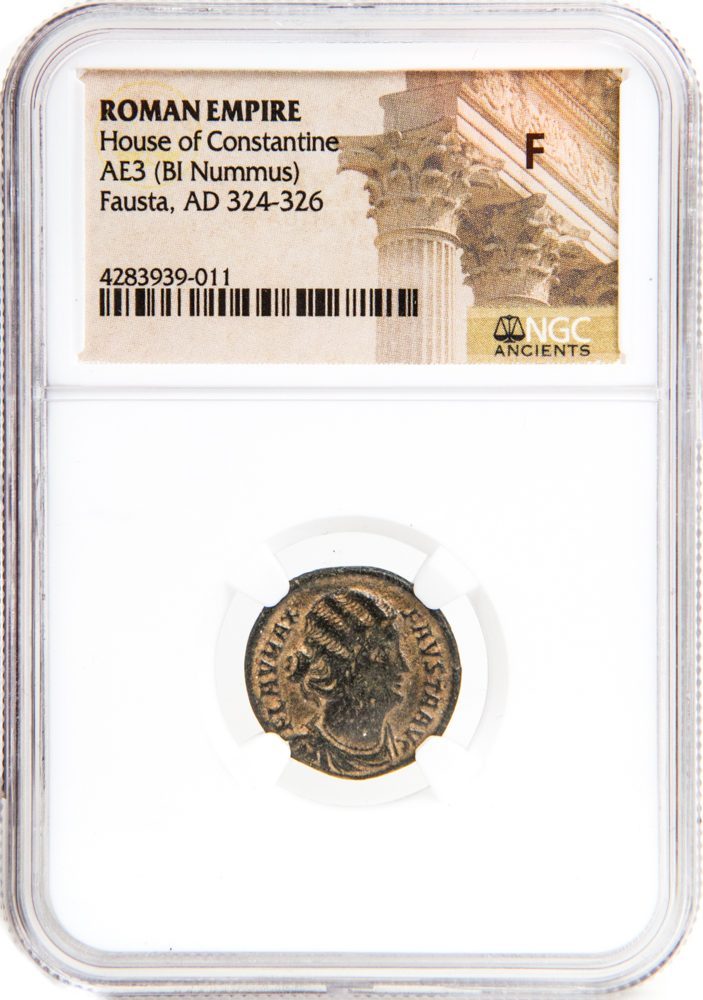
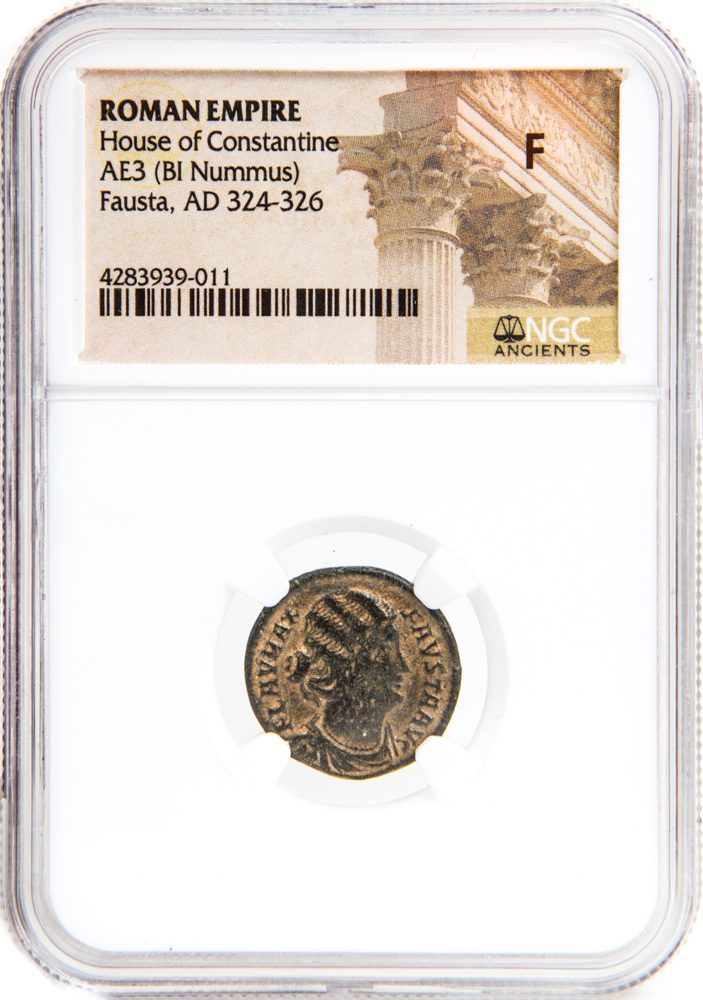
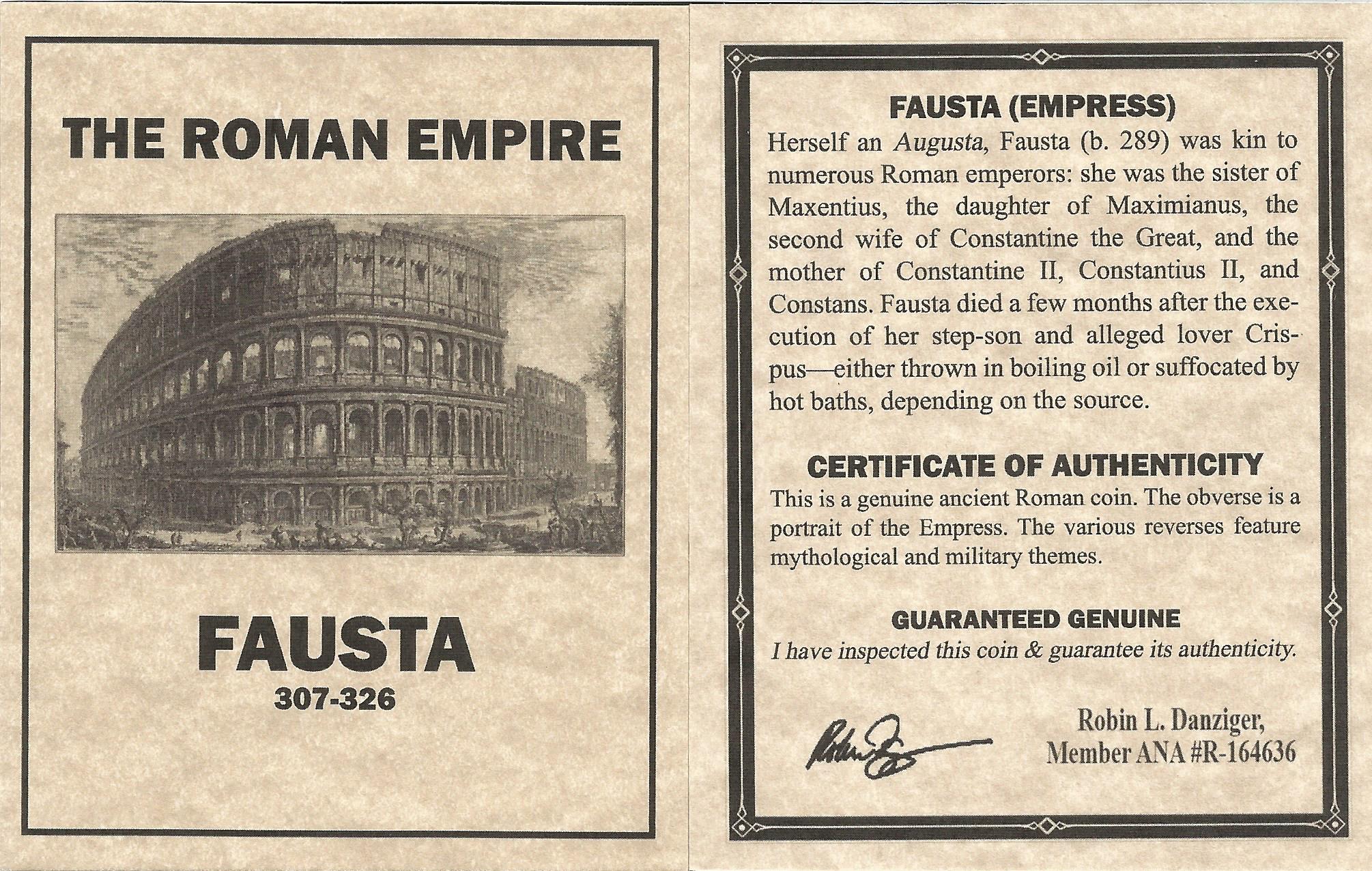
Fausta, the daughter of Maximian and Eutropia, married Constantine in AD 307 and died in 326. Documented bronze comparisons from the 320s show her imperial portrait and a reverse figure carrying two children under SPES REIPVBLICAE. These comparisons do not establish the exact mint or type of an individual offered coin.
Coin facts at a glance
- Portrait
- Flavia Maxima Fausta
- Family
- Daughter of Maximian and Eutropia; wife of Constantine
- Chronology
- Marriage in 307; death in 326; Augusta in 324 or 325
- Comparisons
- Heraclea RIC VII 80 and Nicomedia RIC VII 97
- Reverse legend
- SPES REIPVBLICAE; Hope of the State
- Individual provenance
- Not established by portrait or listing dates
History of the coin
The woman on the coin
Flavia Maxima Fausta belonged to two imperial families. She was the daughter of Maximian and Eutropia, and married Constantine in AD 307. Hans Pohlsander’s scholarly biography places her death in 326. Her birth date remains disputed. He also dates her elevation to Augusta, an imperial honor for women, to 324 or 325 rather than claiming an exact day.
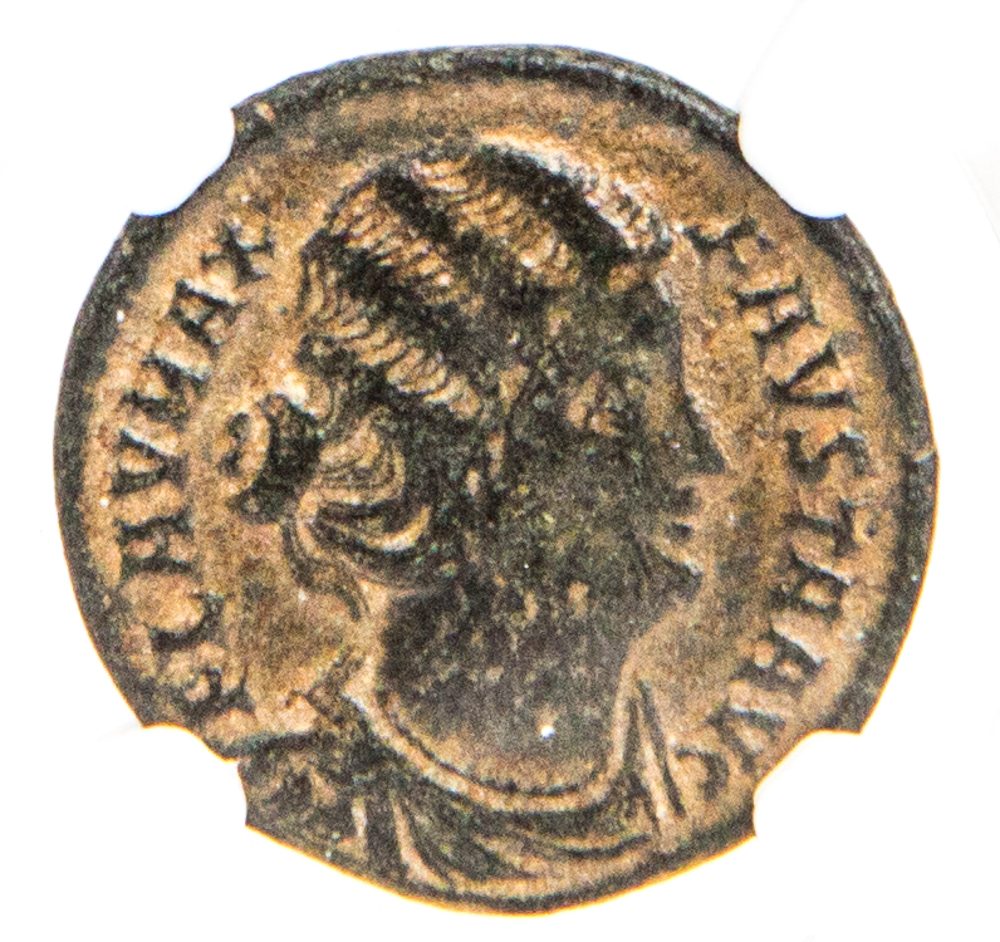
The supplier’s “307–326” heading should therefore not be read as the striking dates of every Fausta coin. A marriage date, an imperial title and a coin’s issue date answer different questions. The portrait and surviving letters must be checked together before assigning a specific type.
References: Pohlsander, Fausta.
Two comparisons from the 320s
The American Numismatic Society’s Online Coins of the Roman Empire (OCRE) records a bronze type from Heraclea dated 325–326, cataloged as Roman Imperial Coinage VII, number 80. Roman Imperial Coinage, often shortened to RIC, is a reference catalog. Its portrait faces right, with waved hair and a mantle. The name and AVG, an abbreviation of Augusta, appear in the inscription. Its reverse shows a veiled figure carrying two children beneath SPES REIPVBLICAE.
OCRE’s Nicomedia entry dates a related design to 324–325, RIC VII, number 97. Numista translates the reverse words as “Hope of the State.” The entries describe the central figure differently: Heraclea calls her Spes, the personification of hope; Nicomedia calls her Fausta. That difference is a reason to describe the visible design carefully, rather than assert an interpretation as the only possible one.
These are catalog comparisons. Neither entry identifies the ECC coin offered here. Their mint marks—the letters identifying a place of production—dimensions and dates cannot be transferred to a supplied specimen without checking its holder and readable inscriptions. OCRE lists both AE2 and AE3 under denomination for these comparisons. The offering’s AE3 order code alone does not resolve its exact type. This article does not assign a mint, RIC number or exact reverse to that specimen.
References: Numista Heraclea381672; Numista Nicomedia450577; ANS OCRE RICVII Heraclea80; ANS OCRE RICVII Nicomedia97.
What the image cannot tell us
An imperial portrait presents a public face. It does not reveal private conversations or explain a death. Pohlsander records Constantine’s order for Fausta’s execution in 326, after Crispus’s death, while questioning later accounts of the offense and method. This article does not repeat those accusations as established events. The family image on a coin is also no proof that its two children record a particular domestic moment.
References: Pohlsander, Fausta.
The offering and the imagined journey
The current Store listing offers one holdered coin with supplier designation F. ECC identifies bronze and the FAUSTA(AE3)NGC order code. Its 43.2 g and 3.4 by 2.4 by 0.4 inch dimensions are holder/package information, not measurements of the individual coin. ECC’s optional box is separate; it is not promised by this listing.
The accompanying story imagines a bronze with a two-child design and a household deciding what to carry on a journey. Its people, payment and transport arrangement are invented. It supplies no provenance or local circulation history for the offered specimen.
References: NGC Ancients guarantee; ANS OCRE RICVII Heraclea80; ANS OCRE RICVII Nicomedia97; ECC: exact Fausta NGC F offering.
Historical fiction inspired by this coin type
These stories imagine people and events around the coin type. They are separate from the documented history and do not describe the provenance of an offered specimen.
One More Place
4 minute read · 763 words
“One More Place” is original fiction set in an imagined Roman town in late AD 325. Doria, Vivia, Maro, their household, the neighbor, driver, journey, chest, payment and dialogue are invented. The two-child design is inspired by cataloged Fausta bronze comparisons. No mint, denomination value, ancient fare, local circulation, legal rule or provenance of the offered specimen is established. The transport arrangement is imagined, not a documented Roman tariff or practice.
Doria had packed the chest three times before her sister said there would be no room for Maro.
“There is room,” Doria said. “He can sit on it.”
“He cannot sit on it and hold the bedding and keep his feet out of the wheel.”
The cart stood outside their door. Vivia’s son was carrying bundles toward it, one under each arm. He was fourteen and had grown taller that winter, though Doria still thought of him as the child who had once hidden in her chest. Now the chest seemed to be taking his place.
They were leaving the town to live with Doria’s brother. Since Vivia’s husband died, the two sisters had used their savings to keep the house. The savings were nearly gone. Their brother had offered a room and work, but they had to reach him with what they could carry.
Doria pressed the folded cloth flat inside the chest. Her husband had made the chest. The lid no longer closed neatly, and a split ran beside one hinge. She had wrapped the bedding around that corner so it would not catch anyone’s sleeve.
“I can stay with the neighbor,” Maro said from the doorway.
Doria looked up. “For how long?”
“Until you send for me.”
His mother took one bundle from him. “We said we would go together.”
“I know.”
But he kept looking at the chest. Doria had said all morning how much they needed it. He had heard her.
“Let us finish loading,” she said. “Then we will see.”
The driver watched her turn the chest onto its narrow side. She pushed it toward the cart’s edge. He shook his head.
“It will move on the road.”
“We can tie it.”
“And what does the boy hold when it moves?”
Doria stopped pushing.
Vivia brought out the little purse for the journey. They had agreed on a payment with the driver, and that money had to stay separate from what they would need afterward. Doria emptied it onto the chest lid to count it again. She already knew there was not enough for a second trip.
One bronze lay face down. Maro turned it over, then back. On one side was a woman’s portrait. On the other, a standing woman held two small children.
“How does she carry both?” he asked.
“They are small,” Doria said.
“I used to be small.”
“You were never as small as you thought. You broke this hinge climbing out.”
“I did not break it.”
“You were sitting on the lid.”
He ran a finger along the split. “Then I can mend it when we get there.”
He spoke as if the chest was certain to go and he was not. Doria picked up the bronze. The tiny figures rested against the woman, one on either side. She put it with the other coins, ready for the driver.
“What do you want to take?” she asked Maro.
He glanced at his mother.
“Tell me,” Doria said.
“My blanket. The knife. And the board.”
The board had squares scratched into it. He and his father had played on it in the evenings. It lay beneath the chest, where Doria had slid it to stop the chest rocking.
She bent and pulled it free. The chest tipped onto its bad corner.
Vivia reached to steady it. Doria caught her wrist.
“Leave it.”
Her sister looked at her.
“We can carry the clothes in bundles,” Doria said.
“And where will we put them afterward?”
“In the room. Until we find something.”
Doria lifted the lid. She took out the cloth, then the dishes wrapped inside it. Each thing looked smaller alone. Soon the chest held only dust and a loose wooden peg that had fallen from its hinge.
Maro picked up the peg.
“You could take this.”
Doria almost laughed. “To remember a broken hinge?”
“To fit a new one.”
She put it in her purse, apart from the coins.
Outside, the driver moved the bundles and made a place behind his seat. Vivia climbed up first. Maro followed with his board pressed flat against his chest.
Doria paid the driver. Then she went back to close the empty chest. It took both hands to bring the lid down. She could leave it with the neighbor, who had offered to keep anything they could not carry. She had no promise that she would ever come back for it.
From the cart, Maro called, “There is room beside me.”
Doria left the chest in the doorway and went to take the place he had kept.
Documented and imagined
Fausta’s family, marriage, title chronology and catalog coin comparisons are documented. Doria, Vivia, Maro, the town, household, driver, chest, payment, journey, gestures and dialogue are invented. The two-child coin image inspires the fictional choice; no fare, local circulation or offered-specimen provenance is established.
Historical references and product evidence
- Pohlsander, Fausta ↗
Checked 2026-10-11: biography; uncertain birth/title dates and later accounts of death. Comparison evidence does not identify the offered specimen.
- Numista Heraclea381672 ↗
Checked 2026-10-11: secondary catalog comparison; RICVII80. Comparison evidence does not identify the offered specimen.
- Numista Nicomedia450577 ↗
Checked 2026-10-11: secondary catalog comparison; RICVII97. Comparison evidence does not identify the offered specimen.
- NGC Ancients guarantee ↗
Checked 2026-10-11: grade guarantee boundaries. Comparison evidence does not identify the offered specimen.
- ANS OCRE RICVII Heraclea80 ↗
Checked 2026-10-11: full institutional type page read in Chrome; dates, portrait, reverse, dual AE2/AE3 terminology. Comparison evidence does not identify the offered specimen.
- ANS OCRE RICVII Nicomedia97 ↗
Checked 2026-10-11: full institutional type page read in Chrome; dates, portrait, reverse, dual AE2/AE3 terminology. Comparison evidence does not identify the offered specimen.
- ECC: exact Fausta NGC F offering ↗
Authenticated Chrome checked 2026-10-11: FAUSTA(AE3)NGC, F, bronze, four gallery images, six in stock; 43.2 g and holder-shaped dimensions are package measurements. Optional box is a separate add-on, not included in this Store offering.
Sources distinguish institutional and independent type research from supplier evidence about a particular offering. Research dates do not establish current inventory.