SALARSNET · COIN HISTORIES
Iceland 50 Aurar: Dragon, Shrimp and KM26a History
Iceland’s 50 aurar coin catalogued as KM26a is associated with the 1986 bronze-plated steel issue. It depicts a dragon on one side and a shrimp with the denomination on the other. Catalog specifications describe the coin type; dates and condition in a supplied lot still require confirmation.
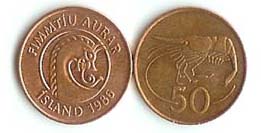
Coin facts at a glance
- Issuer
- Iceland
- Denomination
- 50 aurar; KM26a
- Catalogued issue
- 1986; bronze-plated steel
- Designs
- Dragon and shrimp
- Type diameter
- 19.50 mm; supplied examples not individually measured
History of the coin
Identify the animal before telling its story
The catalog comparison identifies the curled creature as a dragon, rather than the horse named in ECC’s attributes. That distinction changes how the design is read. The shrimp belongs to the reverse, alongside the number 50; the dragon belongs to the obverse. A buyer examining a small worn example should compare the whole design instead of relying on a single outline. The type catalog associates KM26a with the bronze-plated steel issue dated 1986.
The catalog’s type measurements are comparisons, not measurements of a particular delivered coin. They do not establish the weight of a parcel, the condition of every example or a guaranteed assortment of dates. Those are separate product questions.
References: Numista: Iceland 50 aurar, KM26a; ECC: exact ICELKM26a bulk offering.
Marine life and guardians on everyday money
Iceland’s Central Bank documents a broader pairing of marine subjects and guardian figures across its coinage. Its current coin page describes fish and other sea creatures on denominations alongside national guardian imagery. This is useful context for the shrimp and dragon, without implying that the 50 aurar piece is still legal tender.
A small coin can make such imagery accessible through repeated handling and close observation. It need not be rare, precious-metal money or a ceremonial object to be worth comparing. We make no investment or scarcity claim for this bulk lot, and the retail reference price is not the historical face value.
References: Central Bank of Iceland: coins in circulation.
A collectible type, not current spending money
The numismatic catalog records the withdrawal of this denomination in 2003. The Central Bank’s present list of legal-tender coins begins at one króna and does not include 50 aurar. This offering is therefore described for collecting and study rather than current payment in Iceland.
The fiction below turns on a distinction that also matters when cataloguing real products: identifying a coin type is different from establishing the history of a particular specimen. Its museum, gifts and disputed labels are invented. Nothing in the story documents the origin or ownership of any coin in this supplier’s stock.
ECC’s grading guide defines CL as cleaned. That treatment should be disclosed separately from wear, type identification and quantity. The code does not establish a certified numeric grade or promise that every surface looks the same.
References: Numista: Iceland 50 aurar, KM26a; Central Bank of Iceland: coins in circulation; ECC: coin and banknote grading guide.
A collection of examples, not a date set
The type catalog identifies KM26a with a 1986 bronze-plated steel coin. That comparison helps establish what to look for, but a lot of one type is not automatically a complete date set, a matched-quality group or a collection of different varieties. This offering promises a count of coins, not a specific sequence of discoveries.
The supplier lists 100 coins as one purchase unit. Its listing does not document individual specimens. Consequently, historical identification and package identity are kept separate here: the catalog supplies the type comparison; the exact supplier page supplies the lot count. Neither supplies a chain of previous ownership.
References: Numista: Iceland 50 aurar, KM26a; ECC: exact 100-coin lot.
What repeated examples let you examine
A group of the same denomination can invite comparison of lettering, the outline of a shrimp and the curled dragon. The catalog calls the obverse creature a dragon, correcting the horse description in the supplier attributes. The designs should be compared together with the inscription and date, rather than using a worn silhouette alone.
A plated-steel type should not be presented as solid bronze or precious-metal bullion. Its material is also distinct from its surface appearance: color alone does not establish composition. The magnetic observation in the fiction is plausible for the catalogued steel core, but the scene is invented and does not certify the material or condition of a delivered lot.
References: Numista: Iceland 50 aurar, KM26a; ECC: exact 100-coin lot.
Past circulation and present collecting
Iceland’s Central Bank lists current legal-tender coin denominations beginning at one króna. Its descriptions connect marine life with national guardian figures, giving broader context for this small denomination’s imagery. The 50 aurar type is a collecting subject here, not a promise of money usable for current purchases.
The classroom story is set in an imagined 1989 lesson, after the catalogued issue date. A pupil’s unclear example matters to the plot, but it does not predict the wear in the supplier package. The children, school, lost coin and recovery are all fictional. A useful collecting page can explain a type while leaving the individual objects’ undocumented histories open.
ECC’s grading guide defines CL as cleaned. That treatment should be disclosed separately from wear, type identification and quantity. The code does not establish a certified numeric grade or promise that every surface looks the same.
References: Numista: Iceland 50 aurar, KM26a; Central Bank of Iceland: coins in circulation; ECC: coin and banknote grading guide.
Historical fiction inspired by this coin type
These stories imagine people and events around the coin type. They are separate from the documented history and do not describe the provenance of an offered specimen.
Twenty-Eight
4 minute read · 733 words
The characters and events in this story are imagined. The historical setting and coin type are discussed and sourced on this page. This story does not describe the individual coins you will receive.
At the end of the school day, Rúna found twenty-seven coins on her desk and twenty-eight children waiting for the door to open. She counted again without moving her lips. Twenty-seven.
The lesson had sounded simple when she proposed it. Everyone would examine the little bronze-colored coin, draw both faces, and decide which marks identified its country and value. Now it was Friday in 1989, her bus left in twelve minutes, and one pupil would not empty his pockets.
“I haven't got it,” said Ari.
“I didn't say you had.”
“You looked at me.”
Rúna had looked at him because he was holding one pocket closed. That was evidence of something, though perhaps only the terrible condition of the pocket. His mother had asked her not to let him carry scissors home again.
“Everyone check the floor,” she said.
Twenty-eight children bent at once. A pencil rolled toward the radiator. Someone found an orange peel. Someone else announced a coin, but it was a button with four holes, which produced laughter from people Rúna wanted to remain useful.
She put the twenty-seven coins into their paper envelope. The drawings lay beside them. Most children had copied the shrimp successfully. The dragon had become a dog, a bicycle, several dragons, and an animal whose classification its artist refused to discuss.
Ari's drawing was blank on one side.
“Couldn't see it,” he said when she picked it up.
“You had a coin.”
“I had that side.” He indicated the shrimp. “The other side was bad.”
She remembered his request to exchange it. She had told him to work with what he had, because lending out the clearest examples had already become a negotiation about who deserved them. Looking now at the surviving coins, she could see that some faces were much harder to read than others.
She should have paired the children differently. She should have left herself more than twelve minutes.
“Did you take somebody else's to look at?”
“No.”
The answer came so quickly that several children turned toward him. Ari pulled his coat on, covering the hand at his pocket.
Rúna could demand that everyone remain. She could ask the head teacher to search bags. She could miss the bus and walk, carrying a stack of exercise books in weather that had already darkened the windows. None of those possibilities would improve the missing dragon.
“Mine's in the radiator,” said Lóa.
The classroom became quiet.
“How?”
“I put it on top. Then I moved my book.”
“Why didn't you say so?”
“I thought it would come out.”
Rúna knelt. The gap beneath the radiator contained dust and an eraser flattened by many shoes. Farther back, something circular caught the light. It might be a coin. It might be another button, which she would take personally.
She could not reach it. The ruler was too short. Her pencil pushed it farther away.
Ari took his hand out of his pocket. A short piece of string came with it, attached to a small magnet.
“No,” Rúna said.
“I didn't break anything.”
“Where did you get that?”
“Home.”
He had brought it to test things during the lesson. He admitted this in stages: first the magnet, then the testing, then the fact that he had tied the string around it so it would not fall somewhere he could not reach. It had spent most of the lesson stuck beneath his chair.
Rúna held out her hand. “May I borrow it?”
He hesitated before giving it to her.
The magnet bumped against the radiator, clung, and had to be pulled free. She lowered it again, this time keeping the string taut and away from the metal above. The little coin came out wearing a soft gray fringe of dust.
Lóa took it to the desk and cleaned the loose dust away with a sheet of paper. Nobody cheered. The others were already putting on their coats, unwilling to lose another minute of freedom to the discovery.
Rúna handed Ari his magnet. “Monday, bring it again.”
“Am I in trouble?”
“Monday, we find out what else these coins can tell us.”
He looked at the blank half of his drawing. “Can I finish that?”
She placed the clearest dragon beside his book and gave him her pencil. At the door she asked Lóa to tell the bus driver she would walk home. Ari began with the wing.
Documented and imagined
Documented: the catalogued issue predates 1989, the dragon and shrimp designs, and the bronze-plated steel composition. Imagined: Rúna, Ari, Lóa, the school, the coins borrowed for the lesson, the lost coin, magnet, bus arrangement and all dialogue. Steel can support the magnetic incident, but the story is not a report of a tested supplier specimen or a claim about an actual Icelandic classroom.
The Lower Shelf
4 minute read · 733 words
The characters and events in this story are imagined. The historical setting and coin type are discussed and sourced on this page. This story does not describe the individual coins you will receive.
The horse had been on the label for eleven years, and Elín had been employed at the museum for eleven days. She put her pencil beside the little coin and tried to find a hoof.
There was a projecting snout, a curled body, and something that could be a wing. Turned sideways beneath the desk lamp, it still refused to become a horse. On the other face, a shrimp waited above the number fifty.
At noon the case would close for the summer opening. Elín had promised the director that all the new labels would be ready. She had also promised herself that she would stop correcting people merely because she could.
The old label read: HORSE AND SHRIMP. Gift of Jón Sigurðsson, 1977. The coin beneath it carried the date 1986.
She checked the drawer. Its envelope held three small coins and a folded receipt. One of the coins belonged to the earlier gift. Somebody had replaced it in the case with the brighter example, then returned the original to the wrong pocket. The mistake was almost tidy enough to be intentional.
Jón arrived carrying a thermos. He had donated the fishing photographs along the entrance wall, the cracked compass, and the chair in which he now sat without asking. He poured coffee into its lid.
“Your horse is a dragon,” Elín said.
He looked toward the case. “I haven't owned a horse since I was fourteen.”
“The label.”
“Then you can mend the label.”
She had rehearsed an argument, and his agreement left her holding it uselessly. She showed him the date. That was when he stopped drinking.
“Not my coin.”
“No. Yours is here.”
She tipped the older coin onto a square of clean paper. He leaned forward but did not touch it.
“I remember that one,” he said. “The stain beside the edge.”
“We can put yours back. Or show both, with separate dates.”
“Put mine back.”
The brighter coin would photograph better. The director had specifically asked for something clear enough for visiting children to draw. Elín had spent the morning arranging the light, and the photographer was already somewhere on the road. She explained this without mentioning how badly she wanted her first display to look competent.
Jón tightened the thermos lid. “You can use a different name under the bright one.”
She took a fresh card. Under its heading she wrote the denomination and year, then crossed out a word so forcefully the pencil nearly pierced it.
The director came downstairs carrying a ladder. He had to paint a patch above the entrance before the visitors arrived, and he listened while keeping the ladder balanced against his shoulder.
“Use the bright coin today,” he said. “We can change the donation line afterward.”
Jón stood up.
“Or leave the donation line off,” the director added.
“That would be accurate,” Elín said.
“Good. Done.” He began turning toward the entrance.
“But it wouldn't show the gift.”
He set the ladder down. “We cannot put everything in one case.”
Elín looked at the shrimp. Its tiny legs remained distinct even through the glass. All morning she had been treating the clearer coin as the correct coin, as though clarity settled ownership as well as identification.
“Give me the lower shelf,” she said.
“It has the compass.”
“The compass can move beside the photographs. The coins can sit together, and the children can draw the one they can see.”
“That means another label.”
“I can write another label.”
The director glanced at the clock. “And move the compass?”
“Yes.”
“And no story about the coin belonging to a fisherman unless we know it did.”
Jón gave a short laugh. “I was a fisherman. That doesn't mean every thing in my pocket was at sea.”
Elín cut two cards from the remaining sheet. One identified the older gift. The other identified the 1986 example without giving it Jón's name or inventing where it had traveled. Beneath the dragon she put the word she should have looked up before she spoke.
The photographer arrived while she was carrying the compass. He asked which coin was the important one.
“Both,” she said. “For different reasons.”
Jón took the ladder from the director and held it steady. When the first children came through the entrance, he was still there, looking upward and telling the man with the paintbrush that he had missed a corner.
Documented and imagined
Documented: the catalogued 1986 coin type and its dragon and shrimp designs. Imagined: the late-1980s museum, Elín, Jón, the director, the photographer, the earlier donation, its label, the substituted coin, every conversation and the display changes. The older coin is deliberately not attributed to a specific issue; no actual museum or donor history is asserted.
Historical references and product evidence
- Numista: Iceland 50 aurar, KM26a ↗
Independent type comparison for date, material, dragon, shrimp, dimensions and demonetization. Catalog facts describe a type, not the supplied lot.
- ECC: exact 100-coin lot ↗
Signed-in source page checked for 100 coins per lot, order code, representative photograph and retail reference. No exact numeric stock was disclosed.
- Central Bank of Iceland: coins in circulation ↗
Primary current legal-tender list and descriptions of marine and guardian designs; these current denominations are not the offered 50 aurar type.
- ECC: coin and banknote grading guide ↗
Supplier explicitly defines CL as cleaned. This is a condition disclosure, not independent certification or a uniform wear grade.
- ECC: exact ICELKM26a bulk offering ↗
Saved supplier observation for order code, minimum, retail reference and quantity tiers. Its horse attribution is corrected against the independent catalog.
Sources distinguish institutional and independent type research from supplier evidence about a particular offering. Research dates do not establish current inventory.