SALARSNET · COIN HISTORIES
Gratian AE2 Bronze Coins: Imperial History, Reverse and Story
Gratian was co-Augustus from AD 367 and senior western Augustus after 375, before his death in 383. Documented AE2 coins include restoration imagery with an emperor raising a kneeling figure. A particular coin’s mint, date and design require individual attribution.
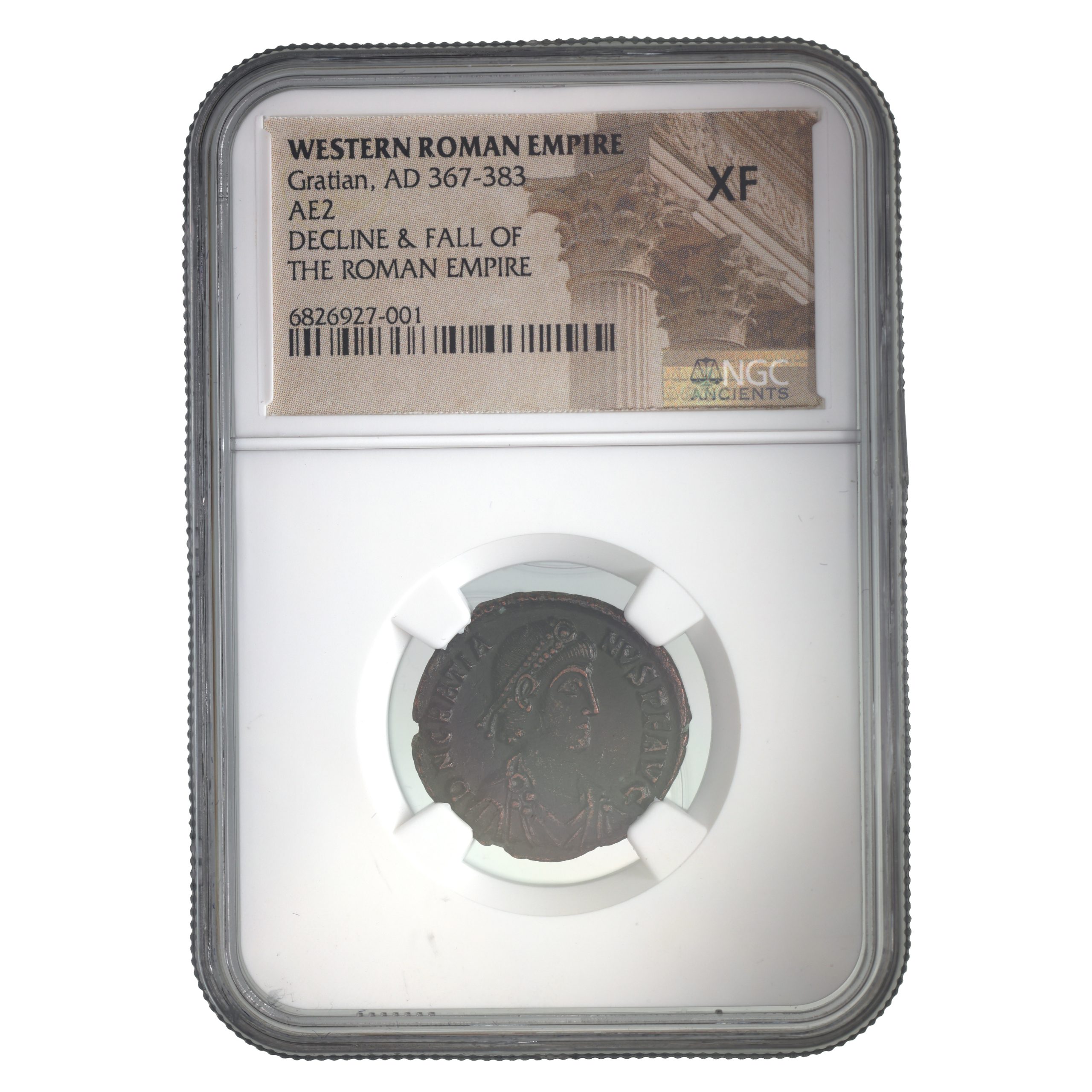
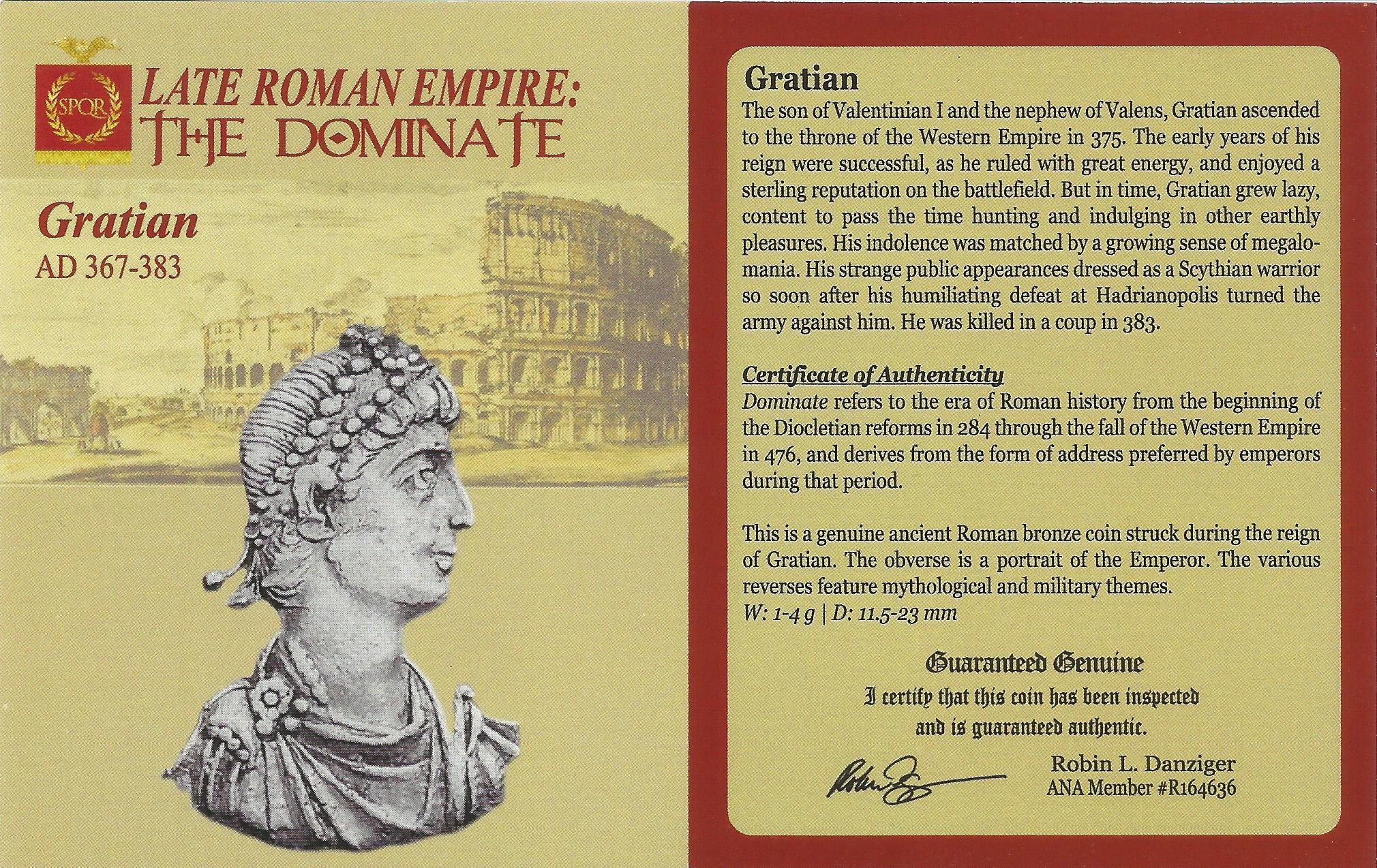
Coin facts at a glance
- Authority
- Gratian; Roman Empire
- Imperial chronology
- Co-Augustus from AD 367; senior western Augustus from AD 375; died AD 383
- Coin comparison
- AE2 / nummus bronze-group example
- Documented reverse comparison
- REPARATIO REIPVB; imperial assistance and restoration imagery
- Individual provenance
- Not established by a portrait or ruler’s reign dates
History of the coin
From child co-emperor to senior western ruler
Valentinian I made his son Gratian co-Augustus in AD 367, when the child was eight. After Valentinian died in 375, Gratian became senior Augustus in the west; his younger half-brother Valentinian II was also elevated. The AD 367–383 range therefore includes years of shared rule, not sixteen years of sole authority.
In 383 Magnus Maximus challenged Gratian, whose military support collapsed. Gratian was killed at Lugdunum, modern Lyon. Walter E. Roberts’s scholarly account traces the succession and political crisis; the Oxford Classical Dictionary independently summarizes his elevation and overthrow.
References: Walter E. Roberts: Gratian, De Imperatoribus Romanis; Oxford Classical Dictionary: Gratian, Roman emperor.
The emperor raising a kneeling figure
Washington University’s John Max Wulfing Collection catalogs WC 10227 as a nummus AE2 of Gratian from Lugdunum, dated AD 378–383. It shows a pearl-diademed bust and a reverse with the emperor raising a kneeling turreted woman while holding Victory on a globe. The reverse legend is REPARATIO REIPVB. Its RIC reference connects to the American Numismatic Society’s OCRE type record.
That scene presents an image of imperial assistance and restoration. It is a design to interpret, not a photograph of a particular event. The catalog specimen’s mint, dimensions and reverse are comparisons rather than promises about the coin available from ECC. Match the available legends, whole design and mint evidence before assigning a precise type.
References: Washington University: John Max Wulfing Collection WC 10227; American Numismatic Society OCRE: RIC IX Lugdunum 28A.3; ECC: exact Gratian NGC XF AE2 offering.
A portrait does not record its owner’s reaction
An emperor’s death and a surviving coin portrait answer different historical questions. Gratian’s overthrow is documented, but this article makes no claim that his coins were automatically withdrawn or universally refused in AD 383. A coin alone does not record what a merchant thought or the terms of an individual payment.
“The Morning’s Money” imagines a baker and her customers confronting a rumor and an uncertain day’s trading. Their refusals, exchanges, bread, flour and choices are invented. The story supplies neither a documented monetary regulation nor the provenance of a supplied coin.
References: Walter E. Roberts: Gratian, De Imperatoribus Romanis; Oxford Classical Dictionary: Gratian, Roman emperor.
Historical fiction inspired by this coin type
These stories imagine people and events around the coin type. They are separate from the documented history and do not describe the provenance of an offered specimen.
The Morning’s Money
5 minute read · 974 words
Original historical fiction in an imagined market at Lugdunum in AD 383. Neratia, Severus, the merchants, customers, payments and particular coins are invented; this is not the provenance of a supplied coin.
The man wanted a different coin from the one Neratia had given him that morning. He put it beside the bread and kept his finger on Gratian’s face.
“I can’t spend this now.”
“Who told you?”
“The potter.”
“Ask him to come here.”
“He says the emperor is dead.”
Neratia looked beyond the man toward the other stalls. Two people were standing close to the potter, speaking with their heads bent. It had been that sort of morning in Lugdunum: someone arrived running, someone went away slowly, everyone knew more than they had heard.
The man lifted his finger. “I paid you with coins you accepted. Give me change somebody else will take.”
She could see his point. She could also see three people behind him beginning to examine their own money.
Her son, Severus, reached for the coin. “We can exchange this one.”
“Then exchange mine,” said a woman behind the man.
Neratia caught her son’s hand before it reached the till. He pulled away, angry that she had stopped him like a child.
“Let me hear what happened,” she said.
“The emperor was killed.”
“Did the potter see it?”
The man stared at her. “People have seen it.”
“Which people?”
He swept the coin off the counter. “Keep your bread.”
He had already eaten what he bought earlier. Neratia had not meant to accuse him of lying. She had wanted a name, a statement she could turn over as she turned over a coin. But the difference mattered very little once he was walking away.
Severus began sorting the till. He put the portraits he recognized in separate piles. There were faces worn almost smooth and names cut off at the edges. Gratian’s pile grew steadily.
“This is most of it,” he said.
“I can see.”
“We should close.”
“And do what with the bread?”
“Eat it.”
“For how many days?”
He pushed a loaf toward the back of the stall. “Better than exchanging everything and having nothing left.”
That was what she had been afraid of. She had hoped he would say something foolish, so she could be the experienced one.
Neratia went to the potter. He was wrapping bowls, not selling them. When he saw her he put his cloth down.
“I have heard nothing official,” he said before she asked.
“Then why refuse the money?”
“Because I need clay, wood, food. Will you promise that everyone will accept it tomorrow?”
“No.”
“Neither can I.”
On his board stood a jug Neratia had wanted for months. Its lip was shaped so cleanly she had imagined pouring from it without spilling. He was wrapping that too. His hands were gray with dried clay. He had made things that people needed, and still needed other people to take his money.
“I sent you a customer,” he said.
“You sent him back.”
“Yes.”
They stood in silence. Neratia could have bought the jug with bread. She thought of asking, then of Severus sorting the till. She went back without it.
A girl was waiting at the stall, holding a coin in both hands. Severus had told her they were not selling just then. She had taken that to mean waiting might help.
“Which one have you?” Neratia asked.
The girl showed her. Gratian again. Neratia remembered giving it to the girl’s father in change two days before.
Severus watched her.
Neratia took the coin and passed the girl a loaf. The child put the loaf beneath her arm and went away, pleased to have done what she had been sent to do.
“You’ve made the pile bigger,” Severus said.
“Yes.”
“Why?”
“Because I gave her father that money myself.”
“That doesn’t make it safe.”
“No.”
He looked at her as if she had left a sentence unfinished. She had. There were things she could promise about her bread. She had flour enough for another baking, but not enough for several days if the money stopped moving. She could take a coin back without knowing what would happen to it afterward.
“Sell what’s baked,” she said. “Don’t promise tomorrow’s price.”
By afternoon some customers had come and others had turned away. One man wanted to pay less because of the portrait. Another asked whether she knew something the potter did not. She told him she knew how much flour she had left. He laughed, then bought nothing.
Severus sold beside her. He no longer separated the coins as each one arrived. That did not mean he had ceased worrying. Twice she saw him count the loaves behind them.
Near closing, the flour seller came past carrying an empty sack. Neratia stopped him.
“I’ll need flour tomorrow.”
He looked at the coins on her board. “So will everyone.”
“Will you take those?”
“I don’t know yet.”
She nodded toward the remaining bread. “Your sister buys from me.”
“She has a houseful.”
“Take these to her. Bring me what flour you’ll exchange for them in the morning. Agree with me now.”
He counted the loaves. He wanted more than Neratia thought fair. They argued until Severus began covering the stall and told them the light would be gone before either of them became generous.
The flour seller laughed first. They settled the exchange. Neratia helped him fit the bread into the sack, keeping the softest loaf away from the knot.
When he left, the coins were still there. So was most of her uncertainty.
Severus gathered the till. “You might have traded for that jug.”
“I know.”
“It would have been easier to carry.”
“Tomorrow you can carry the flour.”
He picked up the empty bread basket and put it over his head. Through its weave she could just see his expression. “Will anyone recognize me?”
“Not if you stop talking,” Neratia said, and took the basket from him before he walked into the potter’s board.
Documented and imagined
Gratian’s elevation, shared rule and death at Lugdunum in 383 are documented, as are AE2 portraits and restoration reverses. This market’s rumor, refusals, barter, prices and dialogue are invented. The story asserts no actual demonetization order, general acceptance rule, ancient price schedule or connection to an offered specimen.
Historical references and product evidence
- Walter E. Roberts: Gratian, De Imperatoribus Romanis ↗
Scholarly reign account checked for 367 co-Augustus, the 375 succession and the 383 challenge and death at Lyons. Later anecdotes and interpretive assessments are not turned into coin-owner histories.
- Oxford Classical Dictionary: Gratian, Roman emperor ↗
Indexed scholarly abstract corroborates elevation at age eight in 367 and overthrow by Magnus Maximus with death at Lugdunum in 383. Only the abstract’s visible claims are used.
- Washington University: John Max Wulfing Collection WC 10227 ↗
Full university collection page checked in the browser: AE2, Lugdunum, AD 378–383, imperial portrait and REPARATIO REIPVB reverse. Its measurements, mint and reference describe that specimen, not the supplied coin.
- American Numismatic Society OCRE: RIC IX Lugdunum 28A.3 ↗
Full institutional type page checked in the browser: bronze AE2, Lugdunum, AD 378–383 and the restoration reverse. Linked by the Wulfing catalog and used as a comparison; no attribution of the offered specimen is assigned.
- ECC: exact Gratian NGC XF AE2 offering ↗
Exact public supplier page checked in the browser October 5: order code, NGC/XF designation, two representative photographs and Out of stock. Its package measurements are not coin measurements. Current Salars price and availability come from the live product options.
- NGC: guarantee for ancient-coin grading ↗
The grade guarantee is distinct from opinions on authenticity and attribution; no new grading or certification claim is added.
Sources distinguish institutional and independent type research from supplier evidence about a particular offering. Research dates do not establish current inventory.