SALARSNET · COIN HISTORIES
Widow’s Mite: Alexander Jannaeus Prutah History
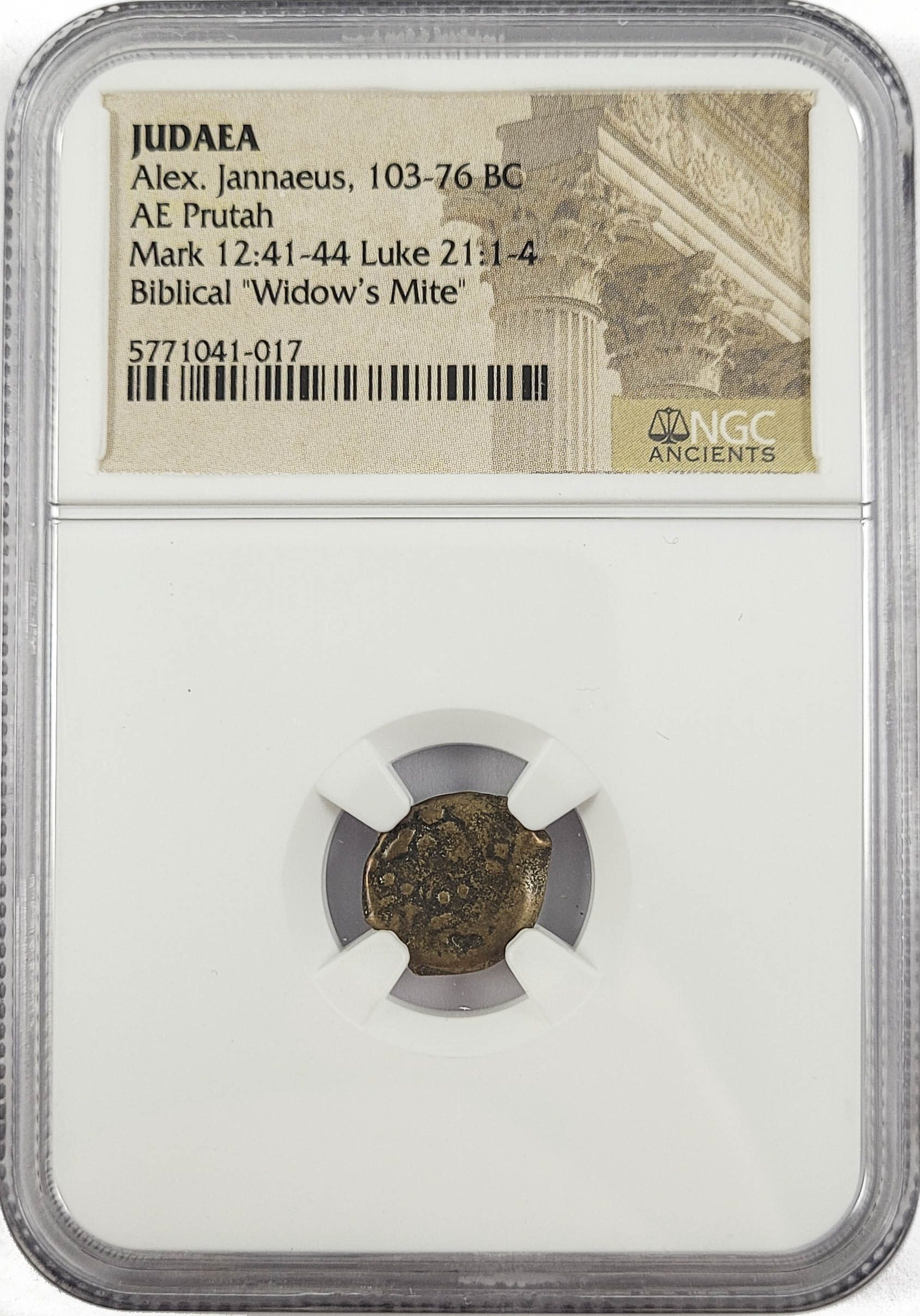
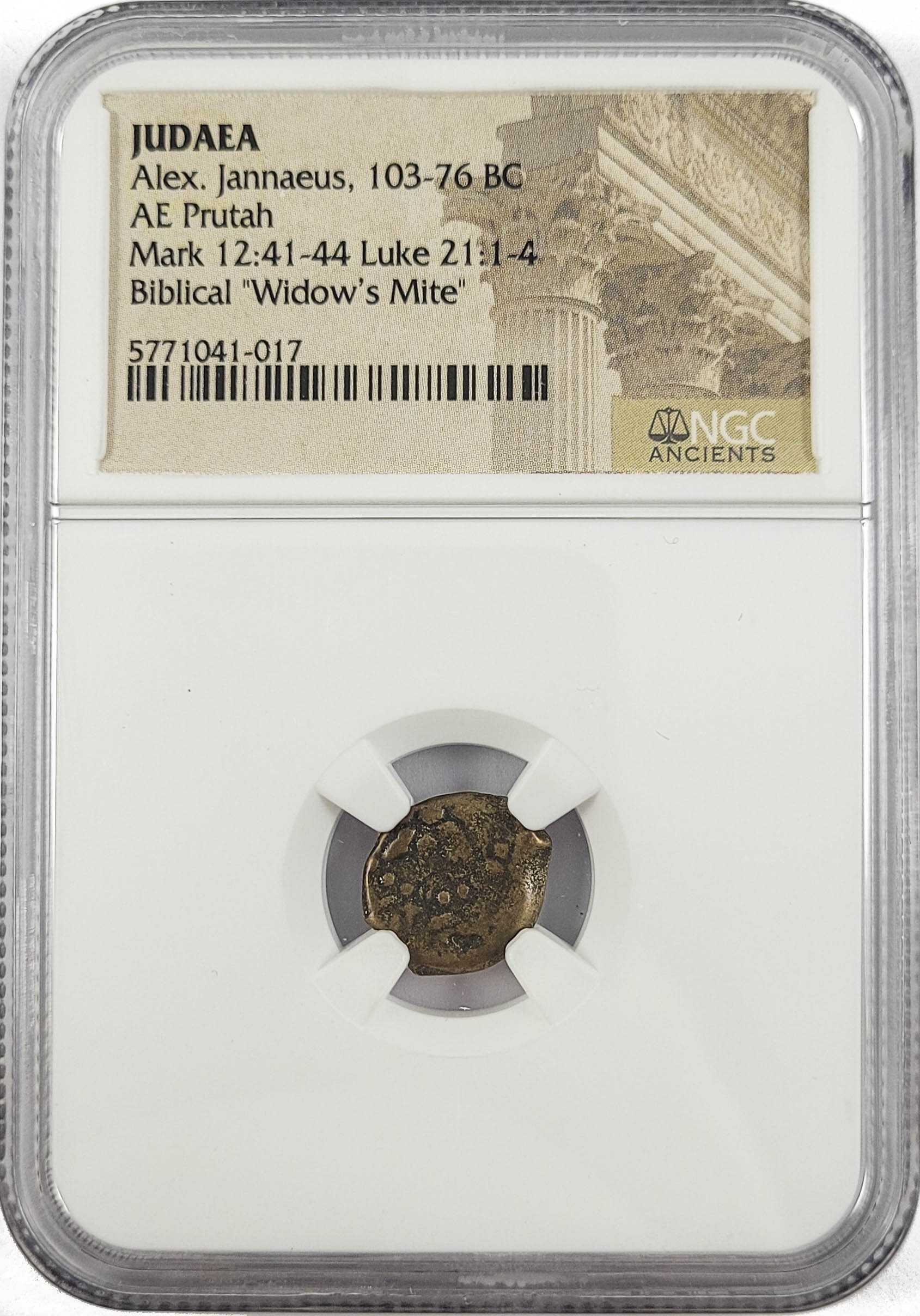
The coin commonly sold as a Widow’s Mite is a small bronze prutah attributed to Alexander Jannaeus, ruler of Judaea from 103 to 76 BCE. Its anchor and star designs belong to Hasmonean coinage. The biblical association describes a collecting tradition; it does not establish the provenance of any particular coin.
Coin facts at a glance
- Authority
- Alexander Jannaeus, Hasmonean Judaea
- Reign
- 103–76 BCE
- Coin type
- Bronze prutah
- Design type
- Anchor and star; surviving detail varies
History of the coin
A ruler’s name in two languages
The offered attribution places this coin in the reign of Alexander Jannaeus, 103–76 BCE. A British Museum prutah record identifies the same ruler and date range, while the Jewish Museum’s bronze example supplies a second institutional comparison. These are references for the historical type, not the specimen that will be delivered. Their measurements and collection histories must not be transferred to this product.
The Posen Library describes a related issue with an anchor, Greek royal lettering, a star within a diadem and Paleo-Hebrew lettering. Its interpretation connects the designs with a ruler working in a world of intertwined Jewish and Hellenistic symbols. The two languages make the coin especially useful for reading how authority was presented in a small, everyday object. A worn example may preserve the principal devices while losing parts of the surrounding text.
References: British Museum: prutah of Alexander Jannaeus; Jewish Museum: bronze coin of King Alexander Jannaeus; Posen Library: Coin of Alexander Janneus.
What the name “Widow’s Mite” does—and does not—say
The familiar collecting name points to the widow’s offering in Mark 12:41–44. In that passage, the emphasis falls on the difference between the modest amount she gives and what it costs her. It is a religious association, not an archaeological identification of an individual coin. The passage does not establish this offered specimen’s ownership, a route into a temple treasury, or participation in the event.
For this listing, the supplier’s specific identification is a prutah of Alexander Jannaeus. We retain that identification rather than treating the English word “mite” as a precise denomination for every related small bronze. The biblical text and the attributed coin type answer different questions: one supplies the later association; the other describes the collectible being offered. Neither gives the modern buyer a documented chain of ancient ownership.
References: Mark 12:41–44, World English Bible.
Reading an ancient coin in a modern holder
A holder lets a collector examine the surviving surfaces without repeatedly handling the coin. It also carries an attribution and any grading information assigned to that particular submission. Here, PROMO identifies ECC’s offering; it does not tell us the grade on the holder you will receive. Ask us to confirm the actual label if that distinction matters to your collection.
NGC’s ancient-coin terms distinguish grading from authenticity and attribution. Those latter judgments are opinions, and NGC does not guarantee them under its ancient-coin guarantee. The holder therefore should not be described as an unconditional authenticity warranty. Read the current terms, compare the attribution with the referenced museum types, and ask about any separately documented seller assurance before deciding.
References: NGC: guarantee for ancient-coin grading.
Historical fiction inspired by this coin type
These stories imagine people and events around the coin type. They are separate from the documented history and do not describe the provenance of an offered specimen.
Cord First
5 minute read · 911 words
The characters and events in this story are imagined. The historical setting and coin type are discussed and sourced on this page. This story does not describe the individual coin you will receive.
The cord had broken where Hannah said it would. Her brother brought the carrying basket back with one handle hanging and three figs crushed into the weave, then put it on her bench as though she had never warned him.
“I need it before the gate gets crowded,” he said.
“You need another basket.”
“I need this one.”
The basket belonged to their father. Everything that belonged to their father had become either too valuable to use or too necessary to replace. His knife lay beside Hannah’s new knife. His awl made a larger hole than hers. His unfinished baskets occupied the shelf where she wanted to keep orders.
Outside, Jerusalem was beginning its day. A donkey objected to something beyond the courtyard wall. Hannah’s brother, Mattan, shifted his weight from foot to foot, measuring the morning against a journey she was delaying.
She pulled the frayed cord through the rim. The break ran deeper than she had hoped. The willow underneath had split too. A new binding would hide the fault and leave the next person to discover it while carrying something heavier than figs.
“How much are you carrying?” she asked.
“Not much.”
He looked at the knife instead of her.
Their neighbor had offered him work carrying jars. Hannah knew about the offer because the neighbor had first asked her whether Mattan was strong enough. She had answered that he was strong enough to tell her himself. Apparently he had not taken the hint.
She turned the basket over. Their father’s crossed bindings were even on the bottom, where no buyer would see them. She remembered the impatient little click he made with his tongue whenever she tried to finish a hidden part quickly.
“I can mend the handle,” she said. “I cannot mend the split underneath it before you leave.”
“Then only mend the handle.”
He said it lightly, offering her an easier task. That was worse than arguing.
On the shelf stood a basket Hannah had finished the previous afternoon. It was broad, with reinforced handles and a bottom she had tested against the stones of the courtyard. A buyer was coming for it. The payment would replace their dwindling bundle of good cord and leave something for food.
Mattan followed her glance.
“No,” she said.
“I didn’t ask.”
“You were about to.”
He took a small bronze coin from the fold of his clothing and laid it on the bench. One side showed a star, worn thin near the edge. Hannah knew that coin. She had given it to him yesterday to fetch cord from a seller who lived beyond the next street.
“You didn’t fetch it.”
“The seller wanted more.”
“You could have come back.”
“I thought I could earn the rest.”
For a moment she saw the morning as he must have seen it: take the basket, carry the jars, return with enough money that the failure to buy cord would become a clever delay. He had even brought the coin back. In his mind the account was almost balanced.
Hannah picked it up. On the other side an anchor lay crooked beneath the ruler’s lettering. Their father had never learned to read those letters. He used to turn the coin until the anchor stood upright and call that reading enough.
Mattan reached for the broken basket.
She put her hand across it.
“Bring the neighbor here.”
“He will choose someone else.”
“Then he will choose someone else.”
Her brother went out angrily enough to leave the courtyard door open. Hannah heard his sandals strike the street, pause, and return at a different pace.
The neighbor came with an empty jar tucked under his arm. He was neither hurried nor pleased. Someone was always asking him to wait; waiting was what lost him a good part of each day.
Hannah showed him the split. He pressed it with his thumb and gave Mattan a look that made the boy study the floor.
“The other basket?” the neighbor asked.
“Sold.”
“Not collected.”
Hannah did not explain what the payment was for. She set the bronze coin beside her knife, took the old basket into her lap, and cut away the damaged section.
Mattan made a small sound.
The cut could not be taken back. Their father’s handle dropped onto the bench.
“Not today,” Hannah told the neighbor. “He can carry with your equipment today. This will be ready tomorrow.”
The man turned his jar, considering. “He carries what I give him. He does not argue about the weight.”
“He tells you if a handle starts to fail.”
The neighbor looked at Mattan. “Can you do that?”
“Yes,” the boy said, without his earlier lightness.
After they left, Hannah opened the reserve bundle of cord beneath her bench. It would be enough if she made the new handle narrower and worked the binding twice around the rim. She moved their father’s unfinished baskets off the shelf. Some she could finish; one she could not, and she put that one aside for material.
When Mattan returned at dusk, he found the repaired basket hanging upside down, drying after its test in the courtyard. Beside it lay the old handle, cut into two short pieces.
He placed his earnings on the bench and reached for the bronze coin.
“Tomorrow,” Hannah said. “Cord first.”
He nodded. Then he picked up one of the discarded pieces, sat beside her, and waited for her to show him where to start.
Documented and imagined
Documented: Alexander Jannaeus’s date range and the anchor-and-star bronze coin type. Imagined: Hannah, Mattan, their workshop, the neighbor, the basket repair, dialogue, earnings and every movement of the fictional coin. Basket-making details are plausible narrative reconstruction, not an attested event or a claim about this specimen. The story is set in an imagined Jerusalem household during the ruler’s reign and does not recreate the biblical widow’s offering.
Historical references and product evidence
- British Museum: prutah of Alexander Jannaeus ↗
Institutional comparison for ruler, date range and anchor/star type; not this offered coin.
- Jewish Museum: bronze coin of King Alexander Jannaeus ↗
Independent bronze example and period attribution. Its specimen measurements are not product specifications.
- Posen Library: Coin of Alexander Janneus ↗
Bilingual legends and scholarly interpretation of anchor, star and diadem; design interpretation is distinguished from observed features.
- Mark 12:41–44, World English Bible ↗
Primary religious text behind the collecting association; no specimen provenance is inferred.
- NGC: guarantee for ancient-coin grading ↗
Current limits of NGC’s ancient-coin guarantee, including authenticity and attribution opinions.
- ECC: exact PROMO product offering ↗
Supplier reference for the offered package, images and order code; not independent historical evidence.
Sources distinguish institutional and independent type research from supplier evidence about a particular offering. Research dates do not establish current inventory.