U.S. COIN COLLECTING GUIDE
Rare coin claims: altered dates, added marks, and the evidence to keep
The larger the claimed premium, the more important it is to establish that the coin, its date, and its mintmark are genuine before assigning a price.
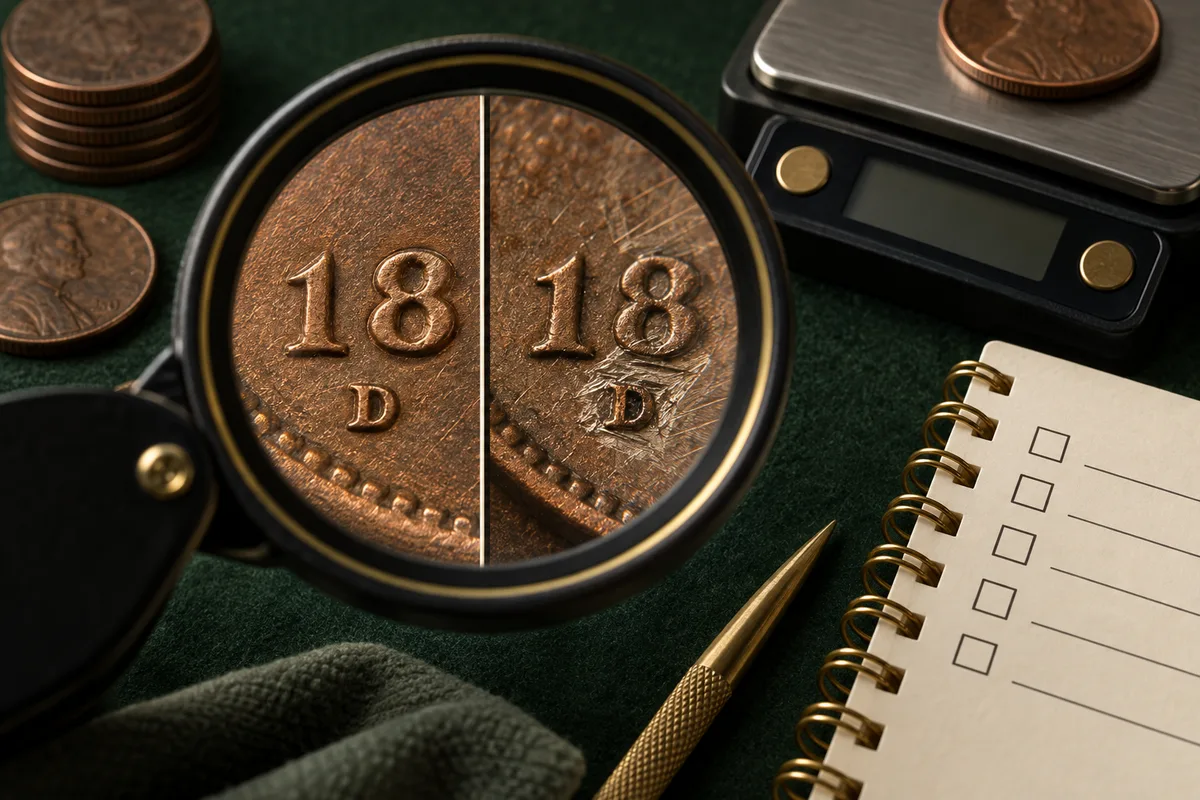
Preserve the first evidence
Do not clean, polish, scrape, or chemically test a candidate rarity. Photograph the whole coin front and back, the edge, the date, and the mint-mark area in several light directions. Record weight and diameter with appropriate tools. Keep the original envelope, proof-set holder, or purchase records because they can help establish context, although packaging alone never authenticates the coin.
Added mintmarks and altered digits
A common coin can be made to resemble a key date by adding a letter or changing a digit. PCGS warns that 1909-S VDB cents and 1893-S Morgan dollars attract counterfeits and alterations. Examine metal flow, surface texture, and the mark’s relationship to nearby design under angled light. Do not rely on one online picture or a single mint-mark position: genuine dies can vary. Match multiple known diagnostics from a recognized source.
Wrong metal and plating traps
The 1943 bronze cent and 1944 steel cent are celebrated off-metal errors, but color alone is not proof. PCGS documents copper-plated 1943 steel cents and altered dates as common traps. A magnet can quickly identify many plated steel fakes, yet further measurements and expert review are needed for a serious claim. Avoid abrasive testing that would damage a genuine coin.
Proof status and missing marks
An ordinary circulation coin without an S does not become a No S proof by description. The 1975 dime is a prominent example: PCGS separates the extremely scarce proof variety from common no-mintmark Philadelphia circulation dimes. Confirm the date, finish, surfaces, and set provenance, then compare actual proof references. Reflections and packaging can obscure tiny details.
Certified coins still need matching
If the coin is in a third-party holder, check the certification number with the issuer and compare the holder image, coin appearance, and label details. A number alone can be copied onto a counterfeit holder. For a raw coin with a potentially large premium, a recognized grading service or specialist dealer can provide an authentication path. Keep the attribution wording provisional until that process is complete.
A cautious listing description
State the observable facts: denomination, visible date, apparent mint mark, measured weight, condition, and exactly which areas are unclear. Link clear photographs and name the reference used. Use “possible” or “unconfirmed” when diagnostics are unresolved. A confident claim should identify the attribution authority and any certification, without treating an AI image or photo review as proof.
Reference reading and real specimens
Use these issue-specific sources to check actual coins. The AI illustration cannot authenticate a coin or establish a rare variety.