SALARSNET · COIN HISTORIES
Maximian Quarter Nummus: Tetrarchy, Abdication and Coin History
Maximian became Augustus in AD 286, governed alongside Diocletian and abdicated in 305 before later returns to power. Institutional catalogs document small bronze nummus fractions with his portrait and a Genius reverse. An individual specimen needs its own attribution.
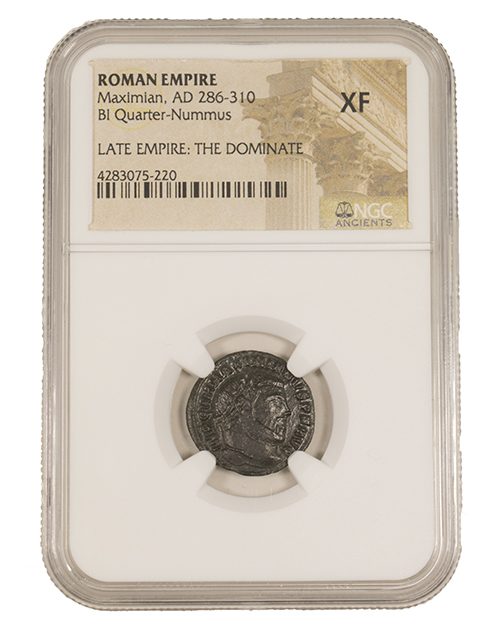
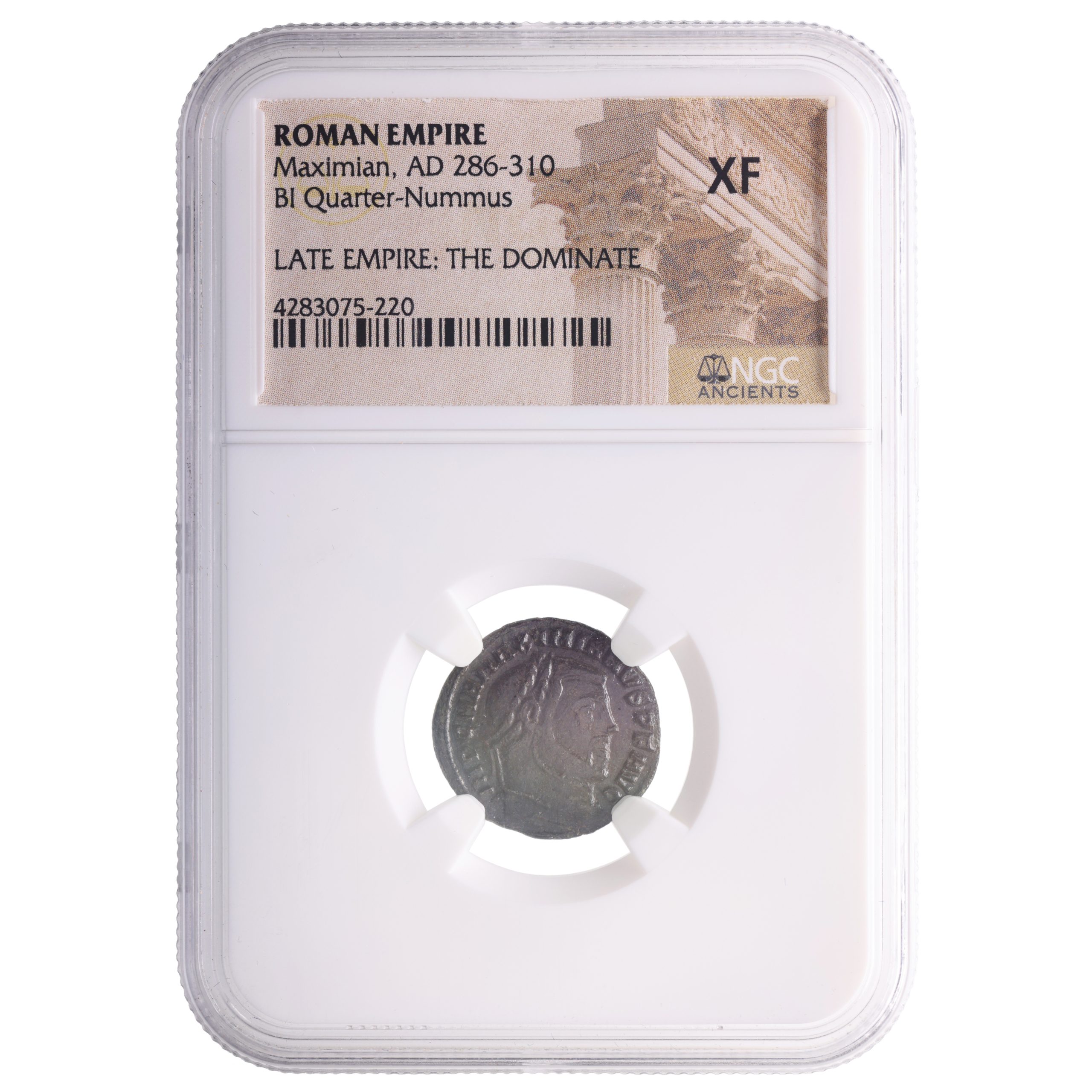
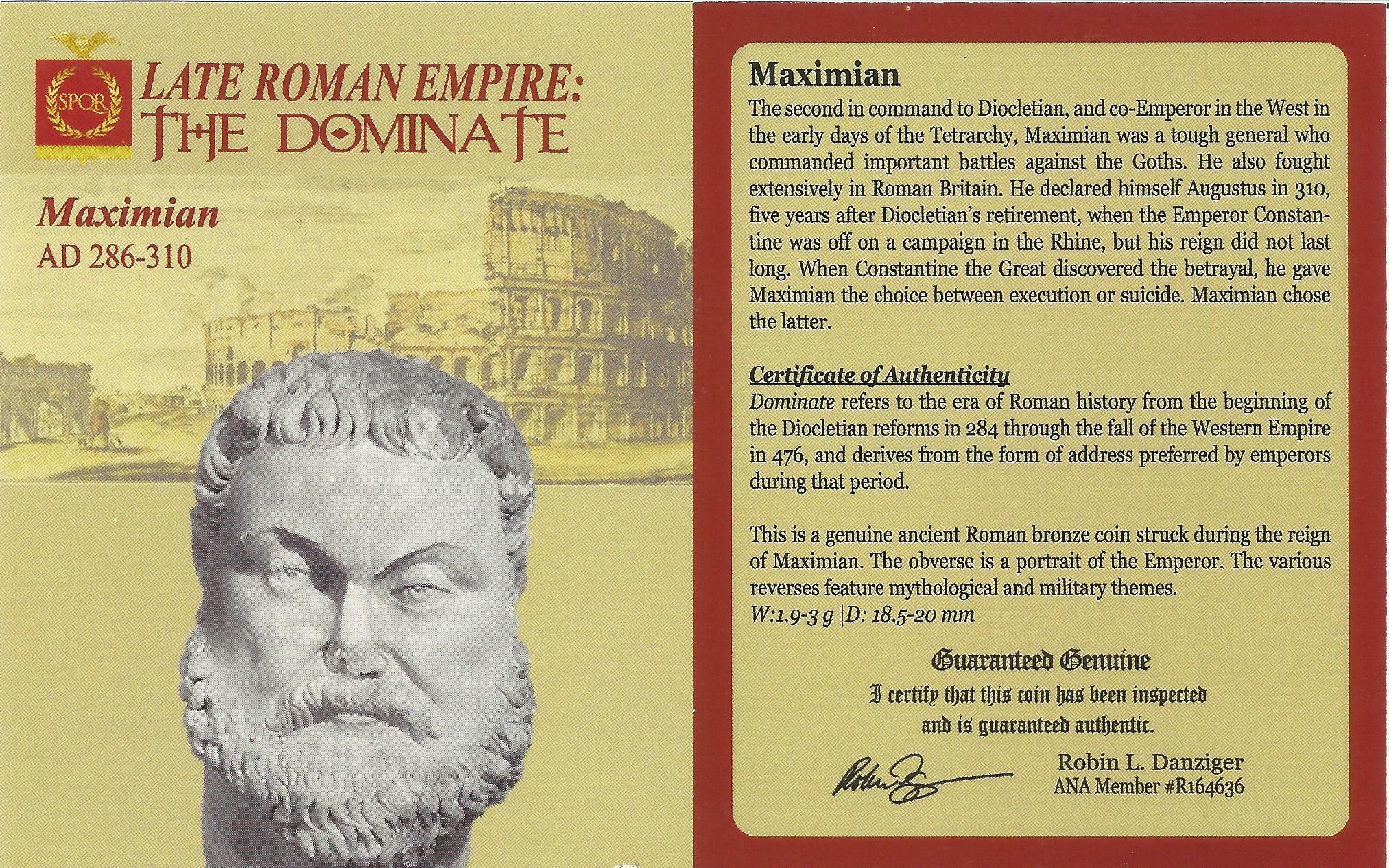
Coin facts at a glance
- Authority
- Maximian / Maximianus Herculius; Roman Empire
- Imperial chronology
- Augustus from AD 286; abdicated 305; later returns; died 310
- Coin comparison
- Bronze nummus fraction; Siscia RIC VI 146
- Documented reverse comparison
- GENIO POPVLI ROMANI; Genius with bowl and cornucopia
- Individual provenance
- Not established by ruler, imagery or listing dates
History of the coin
Maximian and the shared imperial office
Maximian, conventionally distinguished as Maximianus Herculius, became Diocletian’s western colleague as Augustus in AD 286. The arrangement expanded in 293 when Constantius and Galerius became Caesars. The resulting Tetrarchy placed two senior Augusti alongside two junior Caesars; it was intended to strengthen government and manage succession.
Maximian and Diocletian abdicated on May 1, 305. Maximian later resumed an imperial role amid the conflicts involving his son Maxentius and Constantine, and died in 310. ECC’s AD 286–310 heading therefore must not be read as an uninterrupted reign or as the date range of every coin bearing his portrait. Michael DiMaio’s scholarly account supplies this chronology.
References: Michael DiMaio, Jr.: Maximianus Herculius, De Imperatoribus Romanis; ECC: exact Maximian NGC XF quarter-nummus offering.
A small bronze fraction at Siscia
The American Numismatic Society’s OCRE record RIC VI Siscia 146 identifies a bronze fraction of Maximian, dated AD 305. Its obverse has a laureate head and an imperial inscription ending AVG. The reverse legend GENIO POPVLI ROMANI surrounds Genius holding a patera and cornucopia; SIS appears as the mint mark. This is an institutional type comparison, not an attribution of the coin supplied by ECC.
Berlin’s Münzkabinett catalogs object 18228308 as a nummus fraction from Siscia, around AD 305, with the same RIC reference. The museum records an 18 mm diameter and 1.26 g mass for that individual specimen. These small-coin measurements help show why a supplier’s 49.82 g holder/package entry cannot be read as the offered coin’s own mass. Neither the museum’s measurements nor its ownership record transfer to another coin.
References: American Numismatic Society OCRE: RIC VI Siscia 146; Berlin Münzkabinett: Maximianus Herculius, object 18228308; ECC: exact Maximian NGC XF quarter-nummus offering.
Reading the label and the whole design
ECC calls its offering a quarter nummus; the institutional records used here employ the broader terms fraction and nummus fraction. Retain the supplier’s order-code wording while checking the actual label, surviving inscription, portrait, reverse and mint evidence. This article does not establish an ancient purchasing power, a precise exchange rate or a particular striking date for the available specimen.
Genius, the bowl and the horn of plenty belong to the cataloged reverse’s religious imagery. Their presence does not document the beliefs, trade or travels of a past owner. “Two Beds” imagines an older couple making a household decision near Milan in AD 305. Its people, home, coins and negotiations are invented, with no connection to the provenance of a supplied specimen.
References: American Numismatic Society OCRE: RIC VI Siscia 146; Berlin Münzkabinett: Maximianus Herculius, object 18228308; ECC: exact Maximian NGC XF quarter-nummus offering.
Historical fiction inspired by this coin type
These stories imagine people and events around the coin type. They are separate from the documented history and do not describe the provenance of an offered specimen.
Two Beds
5 minute read · 995 words
Original historical fiction in an imagined household outside Mediolanum in AD 305. Daria, Faustinus, Leontia, the house, payments and particular coins are invented; this is not the provenance of a supplied coin.
Daria had brought her own bed. Faustinus had imagined a chest, some clothes, perhaps the cracked jug she refused to throw away. Now two men stood in his courtyard holding a bedstead between them, and Daria was telling them to turn it sideways.
“It went through my door,” she said.
“Your door is wider,” Faustinus said.
“Then we have learned something already.”
One of the men laughed. Faustinus did not. He had swept the house, repaired the roof above the sleeping room and bought a new lamp. For three weeks he had been trying to remember whether there was anything else a woman needed. He had not thought of a second bed.
The house stood outside Mediolanum, far enough from the road that Daria had called it quiet. She had liked the fig tree best. He had taken her liking for the tree, the quiet and himself together, without examining their proportions.
“Put it down,” she told the men. “We can carry the pieces.”
Her daughter Leontia came through the gate with a basket. She looked at the bed, then at Faustinus.
“I told her to ask you first.”
Daria took the basket. “And I told you I was bringing my bed.”
Faustinus found the small bronze coins he had set aside for the carriers. One showed an emperor’s head beneath a wreath. He gave it over without looking further. The men waited while Daria checked that all the wooden pieces had arrived; then they left, delighted to have finished before another piece of furniture appeared.
Leontia had brought food for the evening. Faustinus had also bought food. They discovered this while unpacking, with the bed blocking half the courtyard.
“Then tomorrow is provided for,” he said.
“Will you stay?” Daria asked her daughter.
“I have three children waiting.”
“Bring them another day.”
Leontia tightened the empty basket’s handle in her hands. “You used to say that every day.”
Daria’s face changed. Faustinus looked toward the house. A conversation he had no part in could still make him feel responsible.
“I shall still come,” Daria said.
“It’s a walk.”
“Yes.”
Leontia kissed her mother. She asked Faustinus whether the roof leaked. He told her where it had leaked and what he had done. She seemed to prefer this answer to an assurance. At the gate she turned back.
“Don’t let her carry all of that herself.”
“She hasn’t let me carry any of it yet,” he said.
When they were alone, Daria began untying a bundle. Faustinus stopped her.
“Where do you want the bed?”
“The small room.”
“That is where I keep my tools.”
“I saw it when you showed me the house.”
“You saw the tools too.”
“I thought they could move.”
He had shown her the sleeping room as well. She had stood in its doorway, said that it caught the morning light, and gone on to look at the tree. He remembered the visit with an accuracy that did him no good.
“I have made room beside me,” he said.
“I know.”
He waited. She laid the untied cloth flat so the contents would not spill.
“I have slept alone for eleven years,” she said. “I wanted to come here. I still want somewhere I can shut a door.”
“Against me?”
“Sometimes. Against everyone, sometimes.”
He went into the small room. It smelled of wood and oil. His tools hung on the wall; unfinished work occupied the table. He could move the tools, but the table was too large for the passage, and he would have to take it apart. That had not seemed an inconvenience when the table belonged there.
Daria followed him as far as the doorway.
“You can tell me I misunderstood.”
“You did.”
“Then I can take the bed home.”
He wanted her to argue. If she argued, he could argue back until one of them discovered the right answer. Instead she waited. Beyond her shoulder he could see the courtyard, with her belongings arranged so carefully that each bundle left room for a person to pass.
“You have a house,” she said. “I gave mine up. I should have asked about the room. But I cannot begin by having nowhere that is mine.”
He sat on the edge of the table. A splinter caught his palm. He pulled it out, annoyed at himself for sitting where he would never permit anyone else to sit.
“The table must be dismantled,” he said.
“Yes.”
“The tools cannot lie in the courtyard.”
“No.”
“You could help find a place for them.”
“I could.”
She sounded relieved, but did not smile. He was grateful for that.
They put the tools in a chest beneath the covered part of the courtyard. Daria wanted to hang several from nails; he refused to leave them there overnight. She accepted the chest and made him carry its heavier end. Then he loosened the table’s joints while she held the top steady.
By evening her bed was assembled. His table leaned in pieces against a wall. He would need to make a shelter for it, and work outside until he did. He had expected the house to be improved by her arrival. He had not expected to lose a room.
They ate beneath the fig tree. Daria had unpacked her cracked jug and placed it on the ground between them. He poured too quickly and wet his sandal.
“You must tilt it the other way,” she said.
“It leaks.”
“Only when you pour badly.”
He looked at her. She smiled then, and he laughed despite the wet leather.
Later she stood outside his door with the new lamp. “Where do you want this?”
“Here.”
She put it down and remained beside him for a while. When she went to her own room, he heard the door close. He lay awake, listening to her move things on the other side of the wall, and tried to guess which thing she would want him to move tomorrow.
Documented and imagined
Maximian’s position in the Tetrarchy, abdication at Mediolanum in 305 and later imperial returns are documented. The household, move, relationship, furniture, payment and dialogue are invented. No actual price, denomination exchange rate, local legal arrangement or connection to an offered specimen is asserted.
Historical references and product evidence
- Michael DiMaio, Jr.: Maximianus Herculius, De Imperatoribus Romanis ↗
Scholarly account checked for elevation in 286, the 293 Tetrarchy, May 1, 305 abdication at Mediolanum, subsequent returns and death in 310. Narrative details of the final plots are not asserted as settled facts here.
- American Numismatic Society OCRE: RIC VI Siscia 146 ↗
Full institutional page checked in the browser: bronze fraction, Maximian, Siscia, AD 305, laureate portrait and Genius reverse with bowl and cornucopia. A type comparison, not an attribution of the available coin.
- Berlin Münzkabinett: Maximianus Herculius, object 18228308 ↗
Full museum page checked in the browser: nummus fraction, bronze, Siscia, around AD 305, RIC VI 146, 18 mm and 1.26 g. Its measurements and collection ownership concern this museum specimen alone.
- ECC: exact Maximian NGC XF quarter-nummus offering ↗
Exact supplier page checked October 5: order code, XF, bronze designation, imperial portrait, various reverses, four representative photographs and Out of stock. Its 49.82 g and holder-shaped measurements are packaging, not individual coin measurements. Current Store availability comes from the product options.
- NGC: guarantee for ancient-coin grading ↗
The grade guarantee is distinct from opinions on authenticity and attribution; no new grading or certification claim is added.
Sources distinguish institutional and independent type research from supplier evidence about a particular offering. Research dates do not establish current inventory.